
Published in the Italian Journal of Forest and Mountain Environments
About ten years ago, two men a world apart each sat down to write about the same thing. Pope Francis wrote the encyclical Laudato Si’: On Care for Our Common Home. E.O. Wilson wrote Half-Earth: Our Planet’s Fight for Life. They wrote for different audiences, in different languages, and neither was answering the other. Both arrived at the same message: we must reimagine our relationship to the planet and the way we care for it.
A new peer-reviewed paper by Paula J. Ehrlich, President & CEO of the E.O. Wilson Biodiversity Foundation, sets those two voices side by side and follows their shared message to its consequence: we are embedded in the web of life, so caring for it begins with knowing it. “Reimagining the way we care for our Planet: advancing biodiversity conservation through the hopeful vision of Laudato si’ and Half-Earth” is now published, open access, in the Italian Journal of Forest and Mountain Environments (L’Italia Forestale e Montana).
From a talk in Florence to a paper
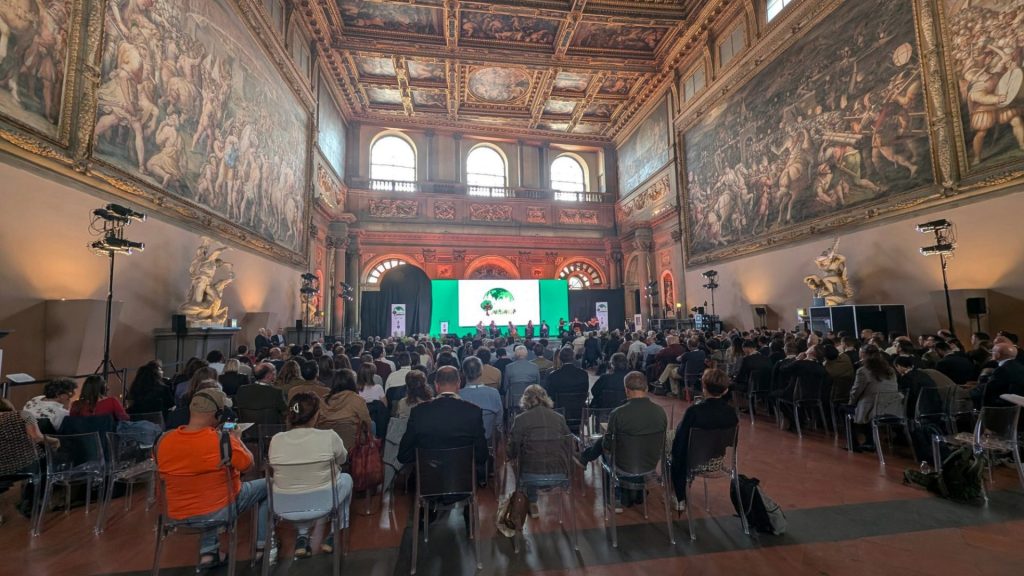
The paper grew from a talk Ehrlich gave on October 1, 2025, at the International Conference Old-Growth Forests and Ancient Trees: A Treasure of Nature, Life, and Culture, which opened in Florence’s Palazzo Vecchio and continued at Vallombrosa. The conference brought together experts in forestry and nature, the human and social sciences, artists, writers and representatives of different faiths, with the aim of a dialogue across approaches and languages. The talk led to an invitation to write it up for the conference proceedings, and this paper is the result. You can watch the talk here.
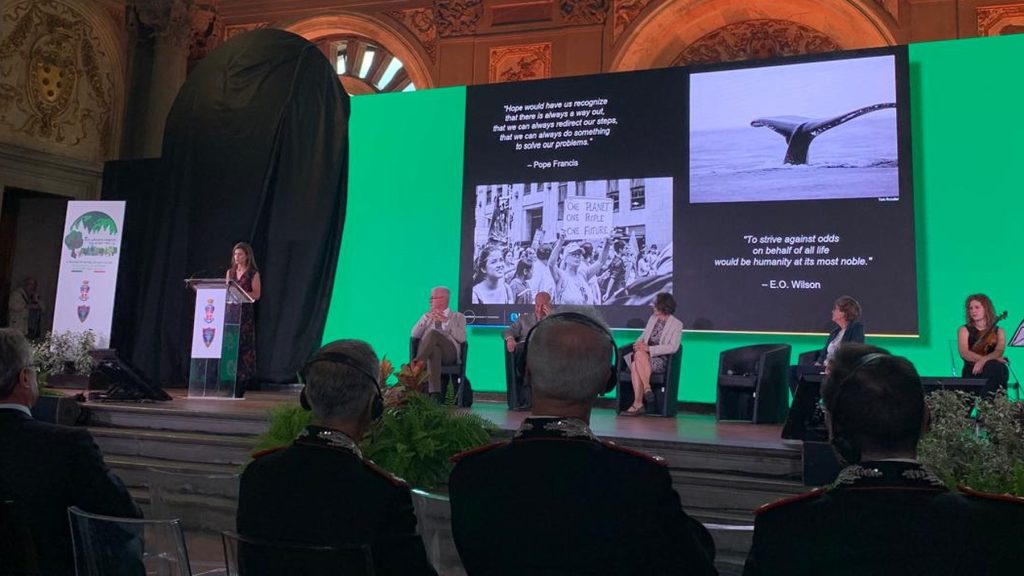
Two voices, one hope
Both writers saw the care of the living world as a scientific, moral and spiritual duty, and both wrote with hope.
"Hope would have us recognize that there is always a way out, that we can always redirect our steps, that we can always do something to solve our problems." — Pope Francis, Laudato Si' "To strive against odds on behalf of all life would be humanity at its most noble." — E.O. Wilson, Half-Earth
Each lifts the other. Pope Francis writes that “because all creatures are connected, each must be cherished with love and respect.” E.O. Wilson, writing from evolutionary biology, puts the same connection in his own words: “The biosphere does not belong to us; we belong to it.” From the theological perspective, humanity’s kinship with other creatures demands reverence and restraint. From the biological perspective, evolutionary history and ecological interdependence demand strategic protection of intact habitats. The paper’s word for where they meet is relationality: humans are embedded within, not apart from, the biosphere.
Neither voice is complete alone. Scientific tools cannot by themselves inspire collective action, and moral appeals cannot by themselves show us where protection will matter most. Together they offer a way forward.

“Reimagining the way we care for our planet requires more than incremental reform. It calls for a transformation in consciousness – one that recognizes humanity’s embeddedness within the biosphere and our responsibility to sustain it.” — Paula J. Ehrlich, from the paper
To protect the web of life, we have to know it
If we are embedded in the biosphere, caring for it begins with knowing it. That is the premise of the Half-Earth Project: we need to know everything we can about the living world, from genes to species to ecosystems, and by mapping the species of our planet we can identify the network of places that matter most for safeguarding biodiversity.
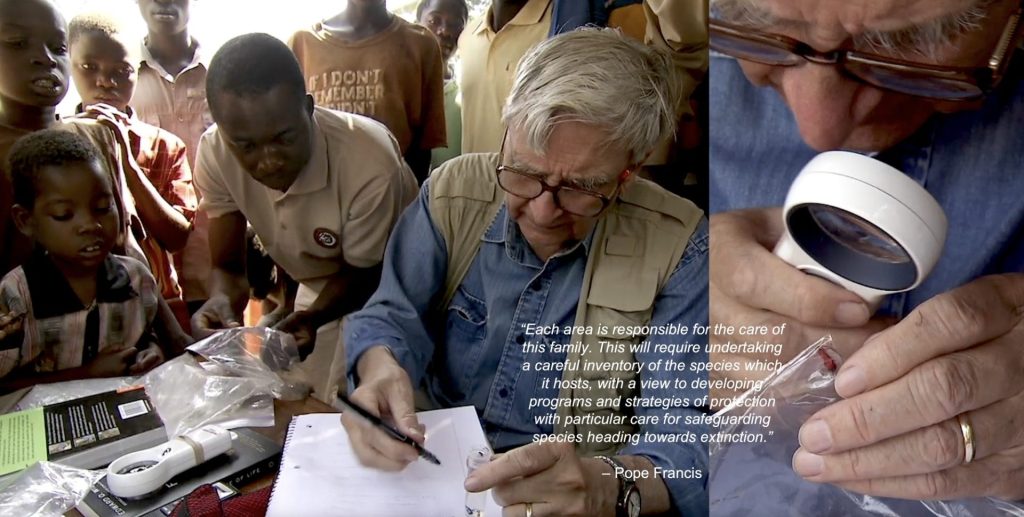
Pope Francis asked for just this kind of knowledge. He wrote that each area is responsible for the care of this family, which “will require undertaking a careful inventory of the species which it hosts, with a view to developing programs and strategies of protection with particular care for safeguarding species heading towards extinction.” A surgeon cannot operate without knowing anatomy, and conservation needs the same kind of knowledge: where species live, and how they interact. Protecting only the places and species we already know, such as our favorite vistas and charismatic animals, risks perversely increasing extinction in the places we do not.
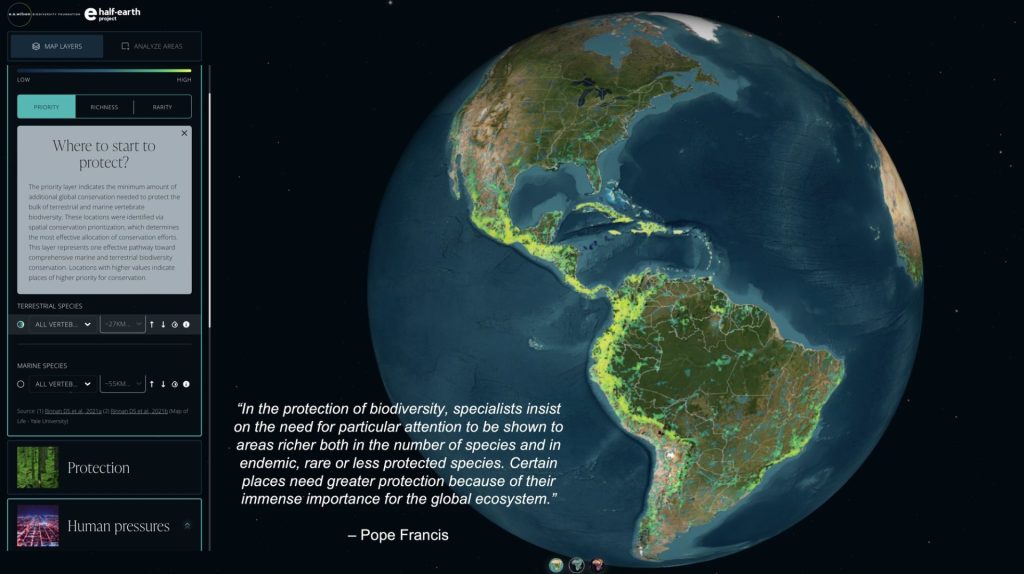
The Foundation’s Half-Earth Project takes up that call. The Half-Earth Project Map, created with Esri, Vizzuality and the Map of Life, brings together conservation priority, species richness and rarity for more than 200,000 terrestrial and marine species, in four languages. It points to Places for a Half-Earth Future: places with extraordinary species richness and rarity that are not yet protected. Pope Francis makes the same case for place: in the protection of biodiversity, he writes, “specialists insist on the need for particular attention to be shown to areas richer both in the number of species and in endemic, rare or less protected species. Certain places need greater protection because of their immense importance for the global ecosystem.”
To know whether protection is working, the Species Protection Index (SPI) scores a country from 0 to 100 on how well its protected areas represent the species within its borders. It was adopted by the Convention on Biological Diversity, and it moves beyond percentage-area targets to measure biodiversity outcomes. Chile and Mongolia, for example, have each protected about 20% of their national territory, yet Chile’s SPI is 39 and Mongolia’s is 81. Mongolia has embraced spatial conservation planning, and the network of places it has prioritized for protection safeguards more of its biodiversity. As the paper puts it, conservation effectiveness depends not only on how much land is protected, but on where protection occurs. Every country’s National Report Card is free to explore on the map.
Two places, one web of life
The paper follows the idea to two places. Neither can be understood through a single species.
Pollino National Park, Italy. Pollino holds a Heldreich’s pine (Pinus heldreichii) about 1,300 years old, one of Europe’s oldest known trees. Its primary forests, with old-growth pine, a layered canopy and standing deadwood, shelter lichens, invertebrates and forest-interior species that depend on a continuity younger forests lack. Among them are the Spectacled Salamander and the Italian Aesculapian Snake, found only in southern Italy and not yet fully protected across their ranges, as the Half-Earth Project Map shows.
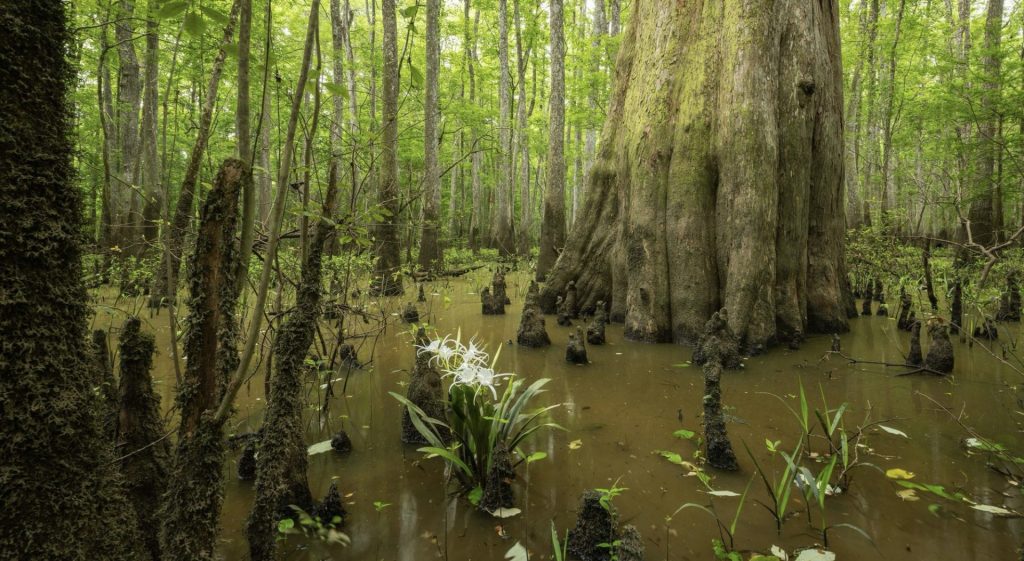
The Mobile-Tensaw Delta, Alabama. Often called “America’s Amazon,” the delta is the home of the newly dedicated E.O. Wilson Land Between the Rivers Preserve, nearly 8,000 acres of wetlands and floodplain forest in the landscape that inspired E.O. Wilson. The preserve holds more than 370 terrestrial vertebrate species, including the federally endangered Alabama Red-Bellied Turtle, found nowhere else on Earth. An Alabama Champion Tree, a bald cypress 430 inches around, anchors the habitat for migratory birds such as the swallow-tailed kite. The kite’s return to the cypress each spring is one expression of the web: a relationship between nesting habitat, insect abundance, migration timing and forest structure that, once disrupted, cannot readily be reassembled.
Knowledge that belongs to everyone
E.O. Wilson urged that we “listen carefully to the heart, then act with rational intention and all the tools we can gather and bring to bear.” Pope Francis wrote: “All of us can cooperate for the care of creation, each according to his or her own culture, experience, involvements and talents.” The Half-Earth Project Map is built in that spirit: open, free and multilingual, so that people everywhere, not only experts and decision-makers, can see what their place holds and take part in protecting it. It echoes the call of Laudato Si’ for an integral ecology, in which ecological responsibility cannot be separated from social justice.
The paper also takes up the questions scholars have raised about the Half-Earth vision, including feasibility and equity, and restates Wilson’s own intent: conservation areas should be chosen in ways that the people living in and around them support, with property rights respected and the cultures and economies of Indigenous peoples, de facto the original conservationists, honored and supported.
The paper ends on hope: informed stewardship, guided by humility and knowledge, can secure a flourishing future for life on Earth.

Read and share
Cite as: Ehrlich, P. J. (2026). Reimagining the way we care for our Planet: advancing biodiversity conservation through the hopeful vision of Laudato si’ and Half-Earth. L’Italia Forestale e Montana, 81(2s), 19–25. https://doi.org/10.36253/ifm-1228
Photos: Jana Mikudová. Slides: Paula J. Ehrlich.