
In the UK, listen to the full episode of BBC Radio 4’s “Great Lives” on BBC Sounds:
This “Great Lives” episode is available on BBC.com, the global BBC app, and “Great Lives” Apple and Spotify podcasts.
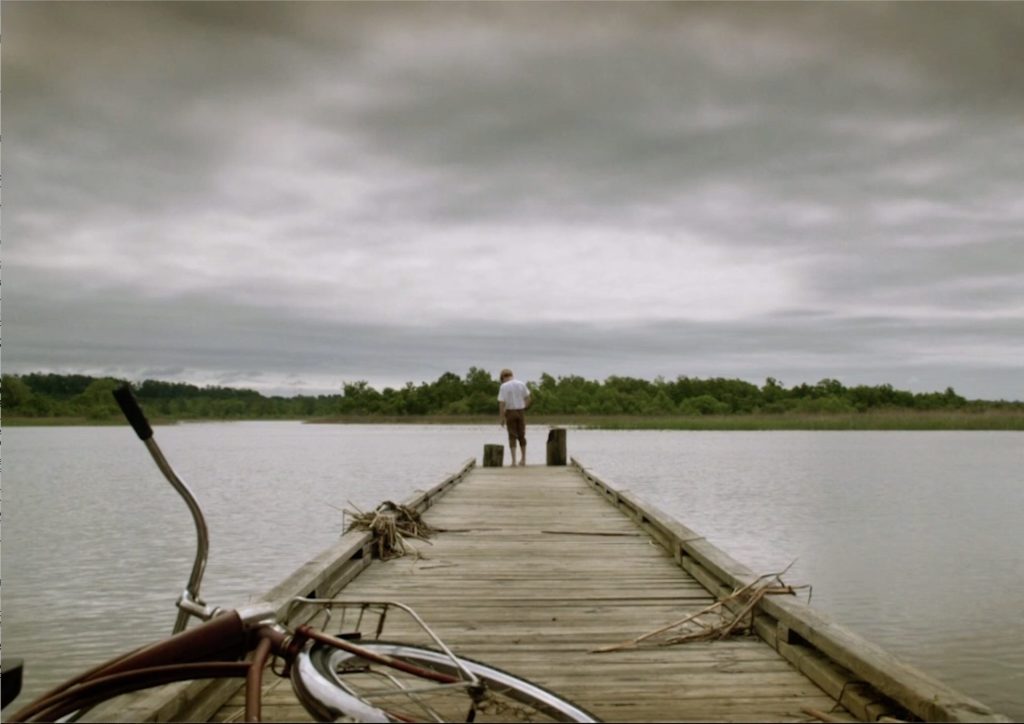
A young E.O. Wilson at the Mobile-Tensaw Delta — Still from “E.O. Wilson — Of Ants and Men,” courtesy of Graham Townsley.
When he was twelve years old, E.O. Wilson would hop on his balloon-tired, single-gear Schwinn bicycle and ride out to the riverfront of Alabama’s Mobile-Tensaw Delta — a place of such exceptional biological richness it has been called “America’s Amazon.” There, one day, he caught the flash of a yellow butterfly wing he had never seen before, and added it to his “butterfly life list.” He carried that Delta with him for the rest of his life. As he was fond of telling anyone who would listen: “I’m not a Harvard professor who was born and raised in Alabama. I’m an Alabamian who went up north to get work.”
This week, BBC Radio 4’s Great Lives — the long-running biography program hosted by Matthew Parris — devoted an episode to the life of E.O. Wilson, nominated by the ecologist and chair of Natural England, Dr. Tony Juniper. E.O. Wilson Biodiversity Foundation President & CEO, Dr. Paula Ehrlich joined the conversation to reflect on Wilson as both a scientist and a friend.
Across the half hour, the program traced the full arc of Wilson’s life: the seven-year-old who lost the sight in one eye in a fishing accident and turned that limitation into an unmatched gift for seeing the small, close world of insects; the young naturalist who went to sixteen schools in twelve years and studied the natural world of every new place he landed; the Harvard scientist whose theory of island biogeography, developed with Robert MacArthur in the 1960s, now underpins conservation policy worldwide — including the work to reconnect fragmented habitat through natural corridors. As Juniper noted in the program, that idea sits at the very heart of what Natural England is working to achieve today.
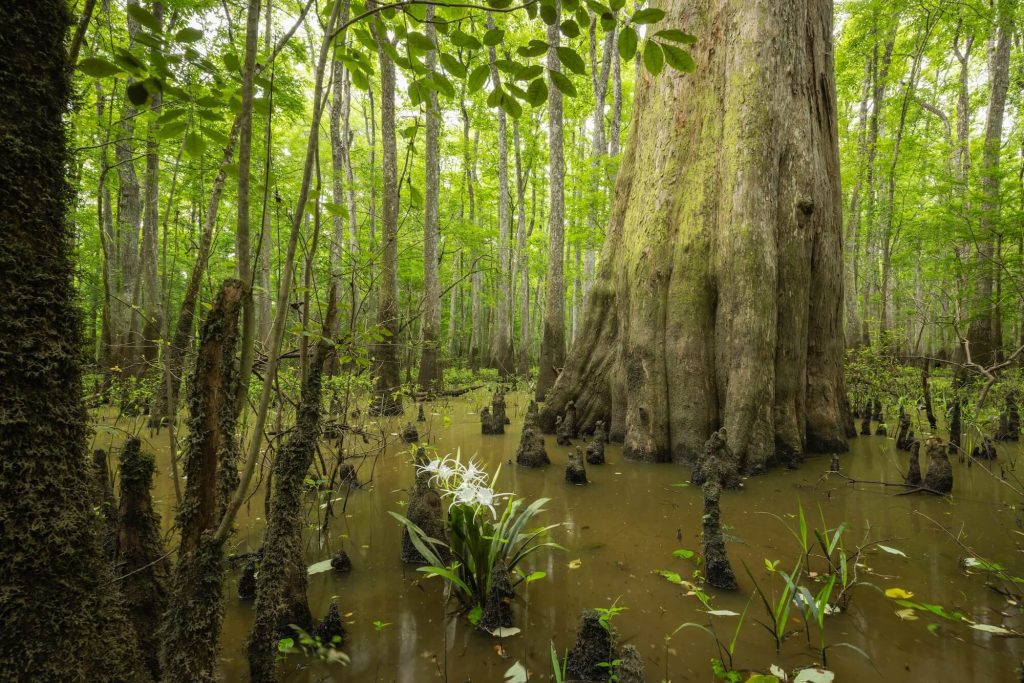
A swamp lily blooms among old-growth cypress in the Mobile-Tensaw Delta.
The conversation also followed the thread from Wilson’s earliest work to his boldest idea. The mathematics of island biogeography — that the number of species a habitat can support relates to its size — is the same science that led Wilson to Half-Earth: the recognition that protecting roughly half the Earth’s lands and seas could safeguard the great majority of its species. As Ehrlich explained in the episode, the essential question has become not simply how much we protect, but which places — which forests, which rivers, which reefs, which overlooked corners of extraordinary richness. That is the work of the Half-Earth Project and its Species Protection Index, now adopted by the Convention on Biological Diversity.
Listeners also heard Wilson himself, in archival clips, reflecting on the fishing accident, on the need to design large and connected reserves, and — in a passage he returned to often — on the predicament he described as humanity’s “Paleolithic emotions, medieval institutions, and godlike power,” and our need to pull back our instinct to take more than the biosphere can bear.
Perhaps the most resonant moment came near the end, when Parris asked whether Wilson created the wave of biodiversity awareness or merely rode one that was coming regardless. Juniper’s answer was an invitation: these stories are not concluded, and the world will need others to pick up the baton. That is the spirit of Half-Earth — a goal large enough to matter, and open enough that each of us has a place in bringing it about.
We are grateful to Dr. Tony Juniper for honoring E.O. Wilson’s life and legacy, and to Matthew Parris and the Great Lives team for bringing his passion and vision to a new audience.
In the UK, listen to the full episode of BBC Radio 4’s “Great Lives” on BBC Sounds:
This “Great Lives” episode is available on BBC.com, the global BBC app, and “Great Lives” Apple and Spotify podcasts.
To explore the science and the places at the heart of E.O. Wilson’s vision, visit the Half-Earth Project Map.