
Harrison Ford passes the award forward — first laureate to the second
"It's my honor to pass the E.O. Wilson Legacy Award to the Gorongosa Restoration Project."
— Harrison Ford, inaugural E.O. Wilson Legacy Award laureate
A Park That Lost Nearly Everything — and Was Restored
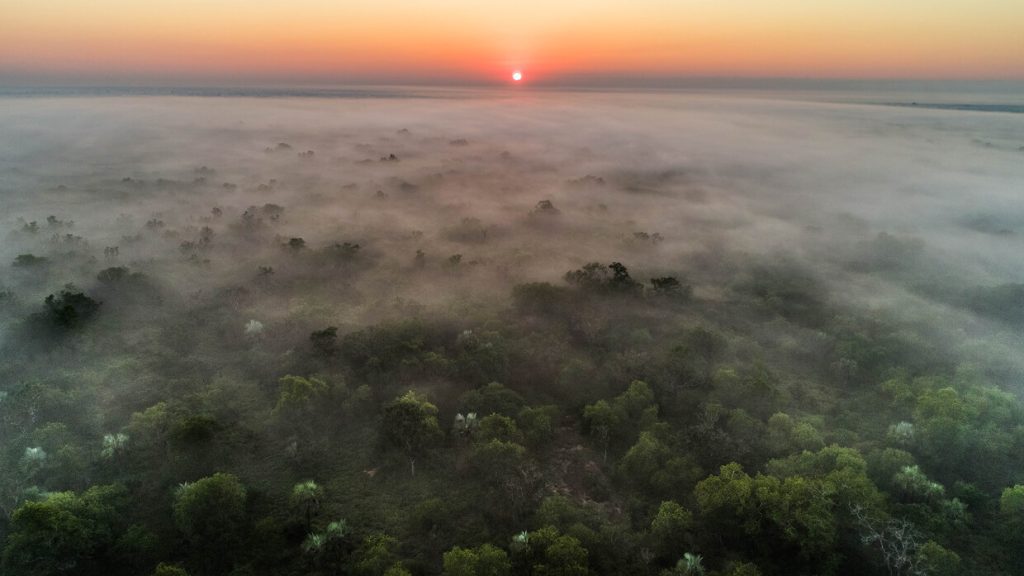
E.O. Wilson wrote a book about Gorongosa National Park, in Mozambique. He called it A Window on Eternity. He went there again and again — collecting ants in the floodplain, mentoring young Mozambicans in the field, looking out over a landscape where our own species began. He believed Gorongosa was one of the most important places on Earth — living proof of what was still possible, if we chose to protect it.
"In Gorongosa, you can see the Earth as it looked and felt before the coming of humanity."
— E.O. Wilson
On October 12, 2026, at Half-Earth Day at Harvard’s Sanders Theatre, the E.O. Wilson Biodiversity Foundation presented the second annual E.O. Wilson Legacy Award for Transformative Conservation Leadership to the Gorongosa Restoration Project. Aurora Malene, CEO of the Gorongosa Restoration Project, accepted the award on behalf of Gorongosa’s scientists, rangers, and the teams working in communities adjacent to the Park in support of education, healthcare, forestry, and agriculture. She was joined on stage by Dr. Susana Carvalho, Gorongosa’s Director of Science, for a conversation with emcee Adrienne Keene.
"Perhaps the greatest measure of restoration is not only what we bring back. It is what we make possible."
— Aurora Malene, CEO, Gorongosa Restoration Project
His Excellency Alfredo Nuvunga, Ambassador of Mozambique to the United States, attended as part of the Mozambican delegation. “For Mozambique, Gorongosa is much more than a national park,” he said. “It is a living symbol of peace, reconciliation, resilience, and hope. Gorongosa has become an inspiring example of how nature can recover, communities can rebuild, and hope can be restored. In many ways, Gorongosa tells the story of Mozambique itself — a nation that has faced adversity but continues to believe in the power of peace, renewal, and partnership.”
Why Gorongosa
The E.O. Wilson Legacy Award honors those who carry Ed’s vision forward through scientific insight, public engagement, and the kind of movement-building that changes what people believe is possible. The Gorongosa Restoration Project was recognized for its embodiment of all three.
Scientific Discovery in Service of Biodiversity
Science has guided Gorongosa’s recovery in partnership with more than 80 universities — including Harvard, Princeton, Stanford, Oxford, and Cambridge. Researchers have documented more than 8,000 species across the Greater Gorongosa landscape, roughly 200 of them new to science. Gorongosa research has produced over 100 peer-reviewed articles, including landmark findings on how decades of ivory poaching drove the rise of tuskless elephants (published in Science), and the discovery of the first fossil sites of the southern end of the African Rift System (published in iScience).
The Park conducts the only Master’s in Conservation Biology based entirely inside a national park in the world. Forty-eight Mozambican students have graduated; alumni now work in national parks, universities, and government. Six staff members hold competitive PhD scholarships at top universities in the UK, Portugal, and South Africa.
The inventory is still growing. A July 2026 survey led by Dr. Jacinto Mathe documented approximately 592 plant, animal, and fungal taxa over 11 days — 48 never before recorded in the Park, including what appears to be a dung beetle new to science.
"Our work today is led by Mozambican scientists and reflects the very essence of what Gorongosa stands for: science in service of people and nature. We believe that science only matters if it builds people alongside knowledge."
— Dr. Susana Carvalho, Director of Science, Gorongosa Restoration Project
Inspiring Collective Action
Between 1972 and 2000, Gorongosa lost more than 90% of its large animals to civil war and its aftermath. Since 2008, restoration has proceeded under a public-private partnership between the Government of Mozambique and the Carr Foundation, led by Greg Carr, who has devoted more than 20 years to this work — always insisting that the Mozambicans stand in the frame. The Park now has more than 100% of the equivalent biomass of wildlife it had in the 1960s. The lion population, in single digits in 2004, now numbers more than 250.
Professor Wilson’s connection to Gorongosa began in 2008, when Greg Carr told him about the restoration agreement. “He looked up at me and he said, ‘That makes my heart go pitter-patter,'” Carr recalls. Wilson went on to visit three times, recording more than 200 ant species, 20 of them new to science, and wrote about the Park in A Window on Eternity (2014). The Park’s research center, the E.O. Wilson Biodiversity Laboratory at Chitengo, is named after him.
"The Gorongosa Restoration Project uses a science-based approach to managing ecosystems to protect biodiversity and to create sustainable human development, while adding to the world's knowledge through discovery, including the greatest story on Earth: human evolution. Science is the center."
— Greg Carr
A Community Ethic of Harmony with Nature
Gorongosa was restored not as a wildlife reserve alone, but as a living community. Guided by a One Health philosophy — the conviction that the health of people, wildlife, and the environment are deeply interconnected — the project has built schools, health clinics, and livelihoods alongside the Park itself. In 2025 alone, 353 mobile health clinics reached more than 160,000 people; 28 new schools were completed serving 15,000 students; and more than 355,000 indigenous trees were planted across 312 hectares. In 2025, the Gorongosa Restoration Project received the prestigious BBVA Foundation Worldwide Award for Biodiversity Conservation, in recognition of this sustained achievement over 20 years.
The Award
The E.O. Wilson Legacy Award for Transformative Conservation Leadership was established by the E.O. Wilson Biodiversity Foundation in 2025. It reflects Wilson’s conviction that “to strive against odds on behalf of all life would be humanity at its most noble.”
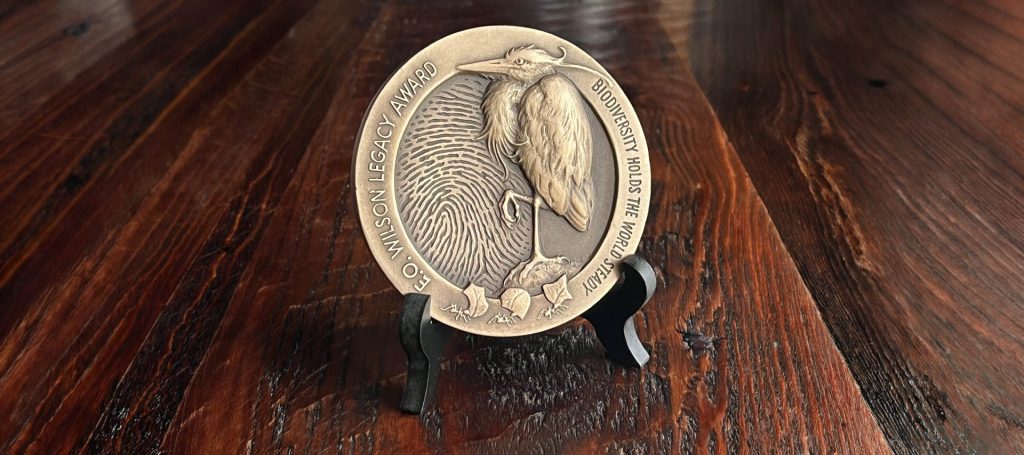
The award was designed by master sculptor and coin designer Heidi Wastweet, and cast in bronze. A thumbprint at the center symbolizes the impact of our human touch on the natural world. A great blue heron — standing over the thumbprint, alert and still — represents natural wisdom and resilience. Along the base, three leaf-cutter ants pay tribute to E.O Wilson’s groundbreaking studies of ants, capturing the spirit of curiosity and reverence for nature that defined his career. Around the rim, the inscription: Biodiversity Holds the World Steady.
"The Living Realization of a Legacy of Hope"
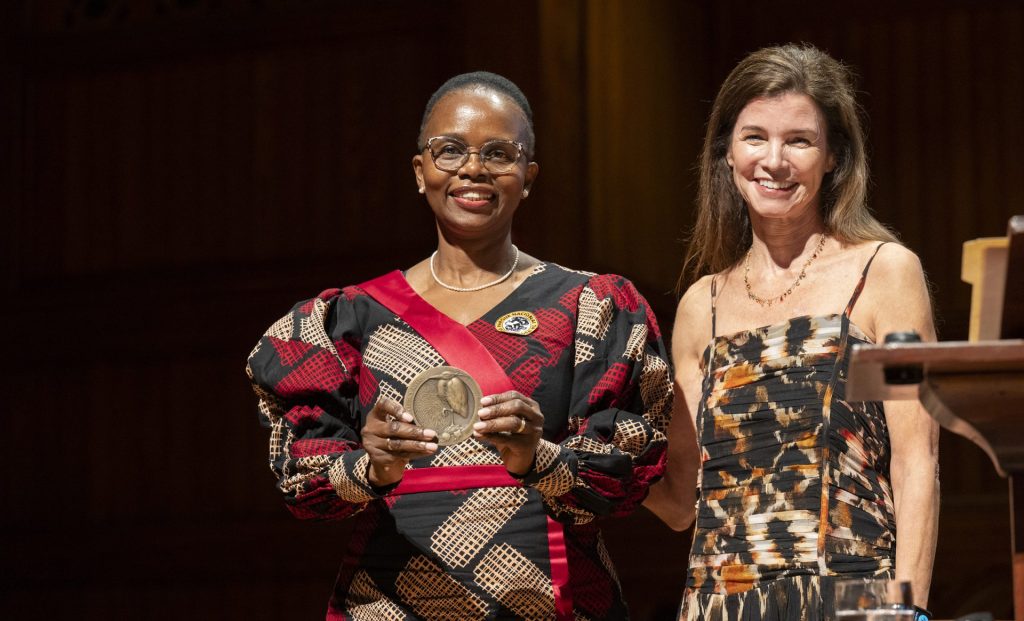
"The Gorongosa Restoration Project is the embodiment of Ed's hopes — the living realization of a legacy of hope."
— Paula J. Ehrlich, President & CEO, E.O. Wilson Biodiversity Foundation
Half-Earth Day 2026
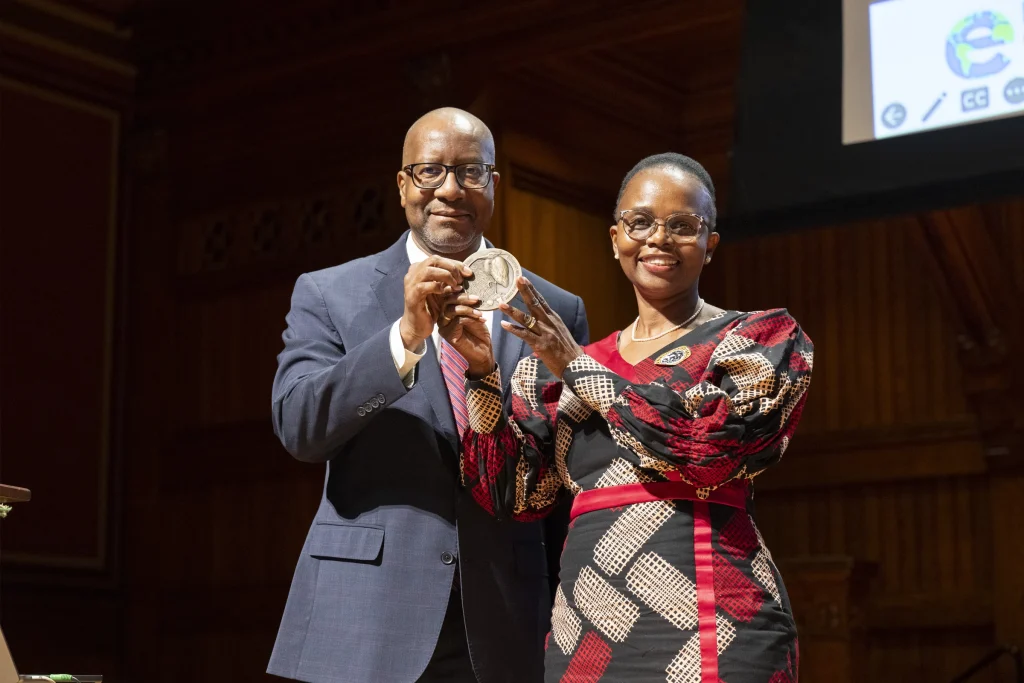
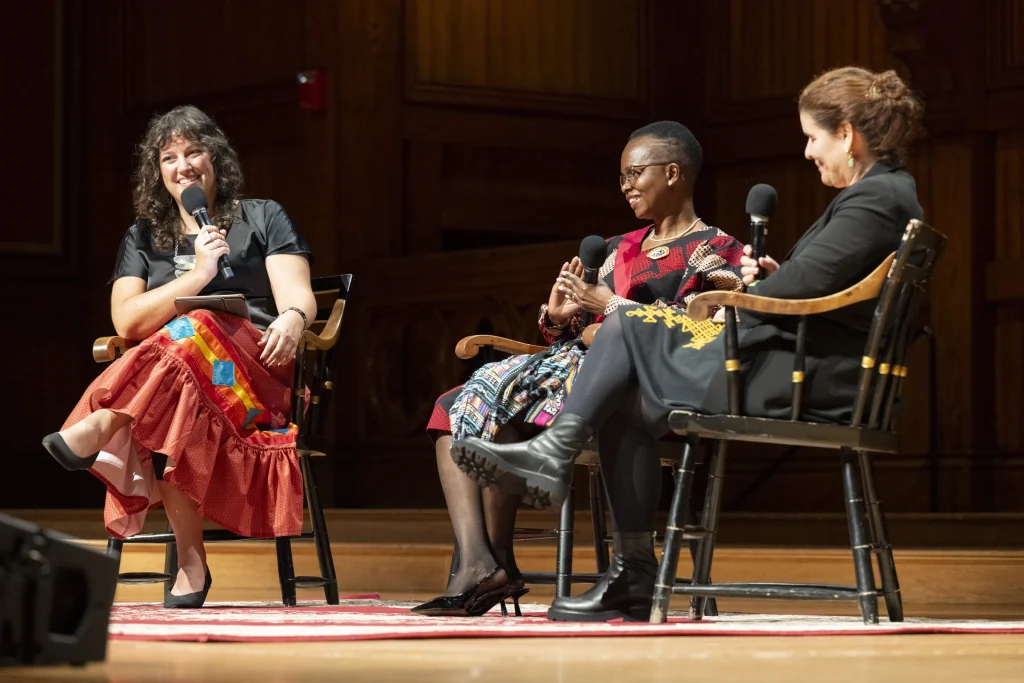

The award was presented at Half-Earth Day 2026, held at Harvard’s Sanders Theatre on October 12, 2026 — marking ten years since E.O. Wilson launched the Half-Earth movement, his call to protect half the planet’s land and sea for the rest of life.