
As millions of students and their families begin their school year. The E.O. Wilson Biodiversity Foundation’s Education team stayed busy over the summer. Just before the July 4th holiday, they visited the U.S. Fish and Wildlife Service’s National Conservation Training Center (NCTC) in Shepherdstown, West Virginia, to participate in the Green Schools Alliance SC3 (Student Conservation Community and Congress).
By: Dennis Liu and Jocelyn Miller
Since 2008, the Green Schools Alliance SC3 (Student Conservation Community and Congress) program has convened high school students from across the country, along with a select group of international students, for a week-long residential program at the U.S. Fish and Wildlife Service’s National Conservation Training Center (NCTC). Students, alum mentors, and faculty collaborate on conservation-themed workshops and design projects aimed at having a positive impact on the environment. I know the power and impact of the program personally, as my daughter Olivia attended the conference 10 years ago. Olivia, inspired by experiences like SC3 and interactions with heroes like E.O. Wilson, is currently the Program and Communications Director for Upstream Alliance, an environmental non-profit that works for clean water and community access to natural areas in the Delaware and Chesapeake Bay regions.
So, when I was invited to deliver a keynote, along with my usual eagerness to share our mission to protect biodiversity, I also felt the warmth of nostalgia and extra pressure to really connect with the audience. I’ve been fortunate to have visited NCTC several times for professional meetings, as well as following the SC3 convenings and the amazing students they engage with. When I work with teachers, I’m always thinking about how to better enable them to pass on our ideas to their students. But the SC3 is an invaluable chance to connect directly with young people who will be the future caretakers of our planet’s biodiversity. In addition, I proposed to the organizers that Olivia and I present together, and that Jocelyn Miller, our Education Program Manager, join us to deliver a hands-on workshop as well.
A Special Place
NCTC is a hidden gem in Shepherdstown, West Virginia. Located an hour from the U.S. Capitol and just upstream of Historic Harpers Ferry, where President Lincoln —wearing a frock coat and tophat —famously climbed only halfway up Maryland Heights overlooking the Potomac River in 1862. It is a remarkable location, in the woods of the Shenandoah Valley and on the Potomac River, and within the unceded ancestral lands of Indigenous Peoples, including, but not limited to, the Massawomeck, Haudenosaunee, the Shawnee, and the Delaware (source USFW).
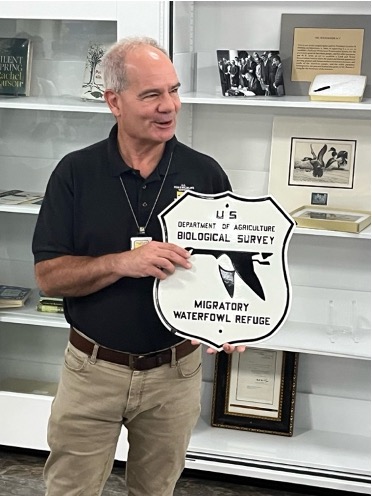
The Center is a testament to the history of conservation, while also providing state-of-the-art facilities for professional training in wildlife and fisheries management, including digital mapping, forestry, invasive species management, water quality monitoring and improvement, and habitat restoration.
Since it’s opening in 1989, presided over by the Mollie Beattie, the first female Director of the US Fish and Wildlife service, NCTC has been the heart of U.S. conservation leadership, a training center for the storied U.S. Fish and Wildlife Service, and a powerful place for students to have a potentially life-changing experience that combines being in nature with relevant academic work in the company of mentors and peers. We are proud to contribute to such a great program.
Connecting Our History to Our Home and Our Future
My talk introduced this young audience to E.O. Wilson through his important scientific work, his conservation ideas, and as an inspiring writer who popularized terms such as biodiversity, bioblitz, biogeography, and biophilia. I tried to convey how the work of early conservatists shaped the works of contemporary writers like Lauret Savoy and Dr. Drew Lanham. I also shared how powerful storytelling and advocacy can transcend generations and continue to offer valuable lessons for addressing today’s environmental challenges. I especially wanted students to hear that people living today need to understand and take action on these issues on their own terms and in their own language. I wanted them to hear that their participation in SC3 is shaping the future of conservation work. I talked about the extinction crisis and why we should care about biodiversity for practical, ethical, and aesthetic reasons. I introduced them to the Half-Earth Project as a specific conservation goal that can be achieved in part through inspiring our Half-Earth Project Map, which gives free access to the most critical information for guiding effective conservation actions. To introduce Olivia to the conversation, I demonstrated how the Half-Earth Project Map can be used to zoom in closely on specific locations anywhere on the globe. I mentioned that conservation action usually takes place locally. Although there are critical hotspots for biodiversity, it’s essential to protect other species wherever they live, including close to home.
Olivia then picked up the baton to show us what conservation action looks like at the local and community level. Olivia did a stellar job of talking about the mission of her organization, Upstream Alliance, which emphasizes clean water and citizen access to waterways for recreational fishing, boating, and swimming. She focused specifically on a project that has cleaned and rejuvenated a long-neglected toxic dumpsite in Camden, NJ, where the Cooper River joins the Delaware Bay, in a very challenged neighborhood. Thanks to the work of numerous private and public partners, and the direct involvement of the community, a large no-go zone right on prime Delaware Bay real estate is now Cramer Hill Waterfront Park, with community members boating, fishing, and walking newly green paths that are home to native insects and birds.
I typically judge how well a talk went by the questions I get. Olivia and I received many questions, and many with lots of thoughtful depth. Students were interested in understanding how our work differed and related to climate work. Olivia responded that, while the climate change discussion seemed endlessly frustrating, good things happened every day in her work. I commented on how much power we have as individuals and communities to act in support of biodiversity, in part as an antidote to the overwhelming dread of the climate crisis. These savvy students peppered Olivia with specific questions about the partnerships and coordination it took to bring the new waterfront park about. I got questions that clearly demonstrated that students understood the principles of protecting species habitat. The group asked me questions about corridors and reserve size, as well as questions about how climate was affecting priority places to protect, as species ranges change with climate.
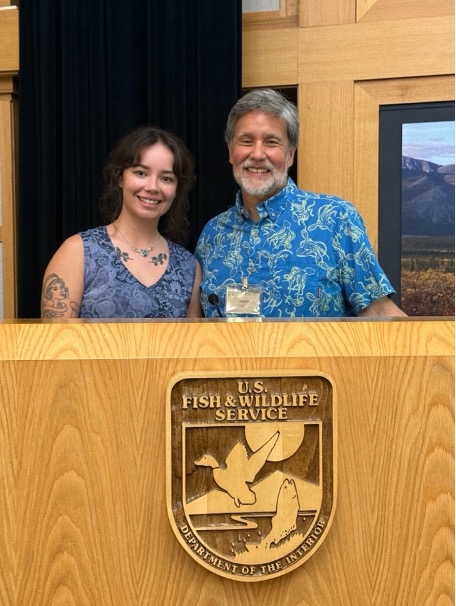
For a dad to be able to present a lecture with his daughter is a remarkable experience, and to have it go so well brings it to the next level. I’m in awe that a person whom I helped find her way is thriving and speaking with a voice that’s all her own, full of quiet authority, and conveying a sense of worthy purpose and hope. After the formal talk and questions, faculty and students approached us, and it was remarkable to answer questions together, to bring our own distinct and complementary perspectives to things that are personally and professionally important to us. That alignment of personal and professional passions is a precious gift.
Designing a Network of Reserves
Beyond the keynote, we were invited to take the SC3 participants through our Half-Earth Project Mapping Design Challenge exercise. The design challenges focus on the global biodiversity, human impacts, and biodiversity reserve data presented on the Half-Earth Project Map. We’ve done these types of design challenges across the U.S., and last year, we took it international, to Cali, Colombia. This time was somewhat different. Typically, we work with Educator Ambassadors to conduct workshops and institutes with teachers. This time, we had the opportunity to experience firsthand how our curriculum resonates with students.
Led by Education Program Manager Jocelyn Miller, students went through a West Virginia-focused Half-Earth Project Mapping Design Challenge. Jocelyn started by presenting some of the key science that fuels the Half-Earth Project Map. Then she set the students to work in teams to design reserve networks of their choosing to protect biodiversity in West Virginia.
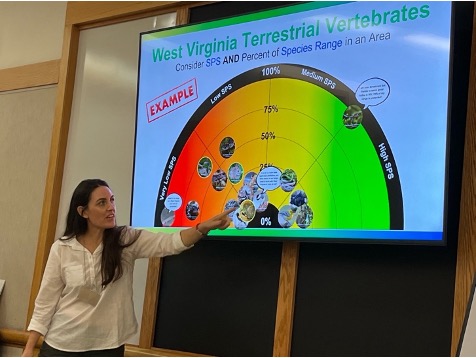
The Education Program has been developing maps for all 50 U.S. states to support the design challenge activity nationwide. Students were energetically engaged, asking so many good questions while diligently laying out their proposed reserves on WV maps.
As Olivia and I moved around the room, answering questions and keeping the student teams on track, it was exciting to see students’ attention to detail and their interest in the metrics, asking, for example, for more information on what species are included in our Species Protection Index, and wanting to understand the calculations behind generating a Species Habitat Score. At the end, each team proudly displayed and defended its various solutions. The students laughed, smiled, and told us it was one of the best classroom activities they had ever done. They loved sorting the species cards in preparation for their mapping work. I was impressed with how effectively Olivia interacted with the students, especially considering she had never previously done this activity. She shared with me how the impact of our minds-on activity and thought Jocelyn was so engaging.


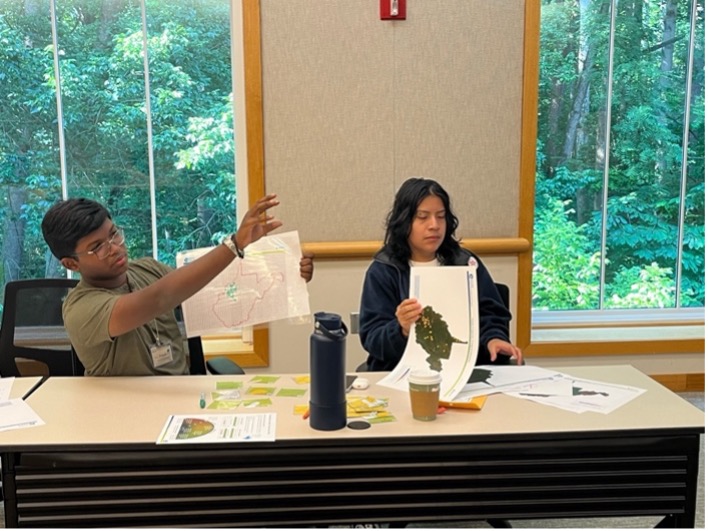
The design challenge began with students sorting species cards and learning about the variety of birds, amphibians, reptiles, and mammals that the state of West Virginia has stewardship over. After students studied information on species cards, they used maps printed from the digital Half-Earth Project Map to designate a single new reserve to protect biodiversity in West Virginia.

After choosing a single reserve and asking lots of great questions, the students used the Half-Earth Project Map to designate up to half of West Virginia as areas to protect for the rest of nature.
On the teacher side, several in attendance inquired about whether we had lessons available for their home states. Fortunately, we have made good headway toward our goal of publishing materials to support design challenges for all 50 US states. For more information and to see our progress, you can visit here and click on the “Half-Earth by State” box.
I hope I’ve conveyed what an exceptional experience this event was, engaging with outstanding students, presenting with Olivia, and, as always, working with Jocelyn. But I sincerely relish every audience. While the majority are teachers, I’ve also worked with college students, adult ESL learners, alum associations, and other conservation professionals. In fact, next month I’ve been invited to talk at a senior care facility. As you can imagine, the audiences in these communities come from highly diverse backgrounds, a challenge I love. The committee that invited me is so excited about the topic of biodiversity that they’ve extended the invitation to other care facilities in the area. My general themes for the talk will remain reversing the extinction crisis and mapping as a tool. Still, I will enjoy tailoring the messages for a mature audience with likely different perspectives from young students.
Dennis Liu is Vice President of the E.O. Wilson Biodiversity Foundation’s Education Program. Jocelyn Miller is the Education Program Manager.