
The award is given to works that exemplify literary excellence on the subject of the physical or biological sciences and communicate complex scientific concepts to a lay audience.
PEN American Center, the largest branch of the world’s leading literary and human rights organization, announced this week the winners and runners-up of the 2025 PEN Literary Awards, the most comprehensive literary awards program in the country. Among the awards is the PEN/E.O. Wilson Literary Science Writing Award, which celebrates writing that exemplifies literary excellence on the subject of physical and biological sciences. Winners receive a cash award of $10,000 and are announced during the annual PEN Literary Awards.
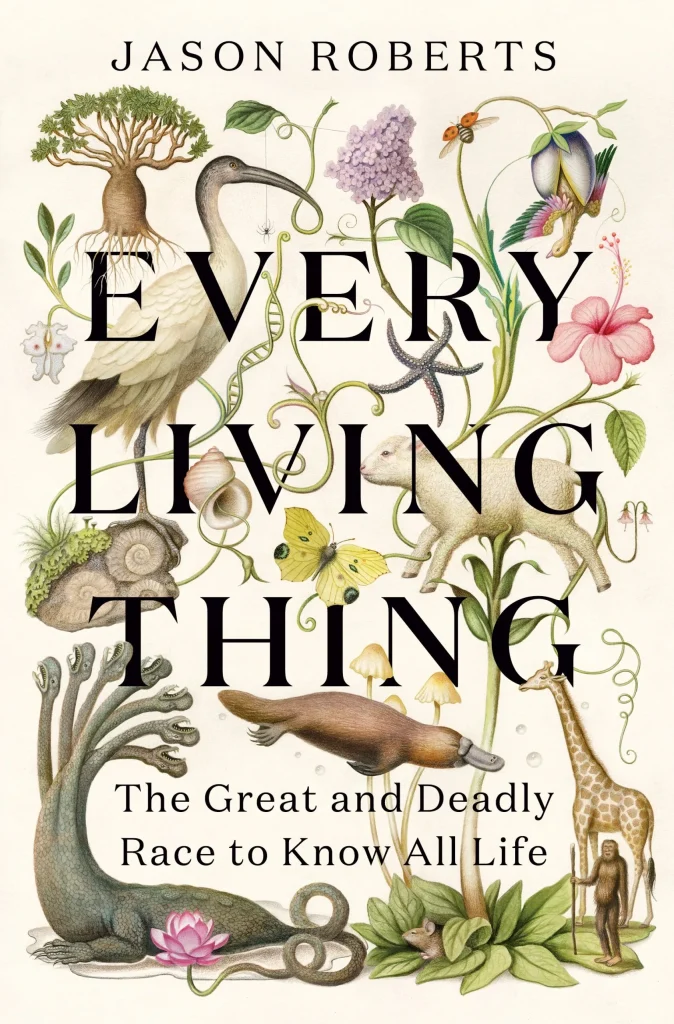
The 2025 PEN/E.O. Wilson Literary Science Writing Award Winner is: Jason Roberts, Every Living Thing: The Great and Deadly Race to Know All Life (Random House)
Book Description
In the eighteenth century, two men—exact contemporaries and polar opposites—dedicated their lives to the same daunting task: identifying and describing all life on Earth. Carl Linnaeus, a pious Swedish doctor with a huckster’s flair, believed that life belonged in tidy, static categories. Georges-Louis de Buffon, an aristocratic polymath and keeper of France’s royal garden, viewed life as a dynamic swirl of complexities. Each began his task believing it to be difficult but not impossible: How could the planet possibly hold more than a few thousand species—or as many could fit on Noah’s Ark?
Both fell far short of their goal, but in the process they articulated starkly divergent views on nature, the future of the Earth, and humanity itself. Linnaeus gave the world such concepts as mammal, primate, and Homo sapiens, but he also denied that species change and he promulgated racist pseudoscience. Buffon formulated early prototypes of evolution and genetics, warned of global climate change, and argued passionately against prejudice. The clash of their conflicting worldviews continued well after their deaths, as their successors contended for dominance in the emerging science that came to be called biology.
In Every Living Thing, Jason Roberts weaves a sweeping, unforgettable narrative spell, exploring the intertwined lives and legacies of Linnaeus and Buffon—as well as the groundbreaking, often fatal adventures of their acolytes—to trace an arc of insight and discovery that extends across three centuries into the present day.
From the judges’ citation:
“What does it mean for a thing to be alive? What are its parts, its mechanisms, its situatedness—what shall distinguish one bit of life from another? And above all, how do we—Homo sapiens—fit into the story of life on earth? The biological sciences have their ways of wrestling with these questions now, but so much of it goes back to two European men who hated each other: Linnaeus and Buffon, the founding fathers of taxonomy. Every Living Thing tells the addictive story of two scientists with radically different personalities, biographies, and—no surprise, then—radically different approaches to their work. Their decades-long rivalry formed the bedrock of an entire field. Roberts’ prose is rich in acutely observed historical and cultural detail and paints a vivid picture of biology as it was before Darwin, geese growing on shrubs and all. Most of all, Every Living Thing is a portrait of science as a human activity, driven by ambition and grudge and status like everything humans do, yet still bending towards an ever-greater understanding of the world. This book is about the past, but one can’t read it without asking: what are the decisions scientists and their sponsors are making today that will affect how we understand the world in future centuries?”
2025 has become a big year for Every Living Thing and Jason, as the 2025 PEN/E.O. Wilson Literary Science Writing Award joins the 2025 Pulitzer Prize for Biography. You can learn more about Jason Roberts, Every Little Thing, and his other works here. Learn about previous winners and the history of the award here.