
with Alexandra Climent of Endangered Rainforest Rescue
For the full story of Alexandra and the ERR in the Darién Region of Panamá, check out the story below.
The forest doesn’t greet you with silence. It greets you with sound, a heartbeat beneath your boots, a song spilling from the treetops, a whisper carried in the mist that rolls between the trunks like breath.
Alexandra Climent had walked for four hours before she reached the grove. Her boots were soaked from crossing the Sambu River, and a leafcutter ant had taken a bite from her ankle, and countless other insects had left their mark, but she barely noticed. Above her, an Emerald toucanet calls, its song drifts like a hollow flute through the misty canopy, a soft, echoing murmur that seems to speak the ancient language of the forest. In the canopy, flashes of scarlet and turquoise darted between the branches, perhaps tanager flocks chasing insects in the light.
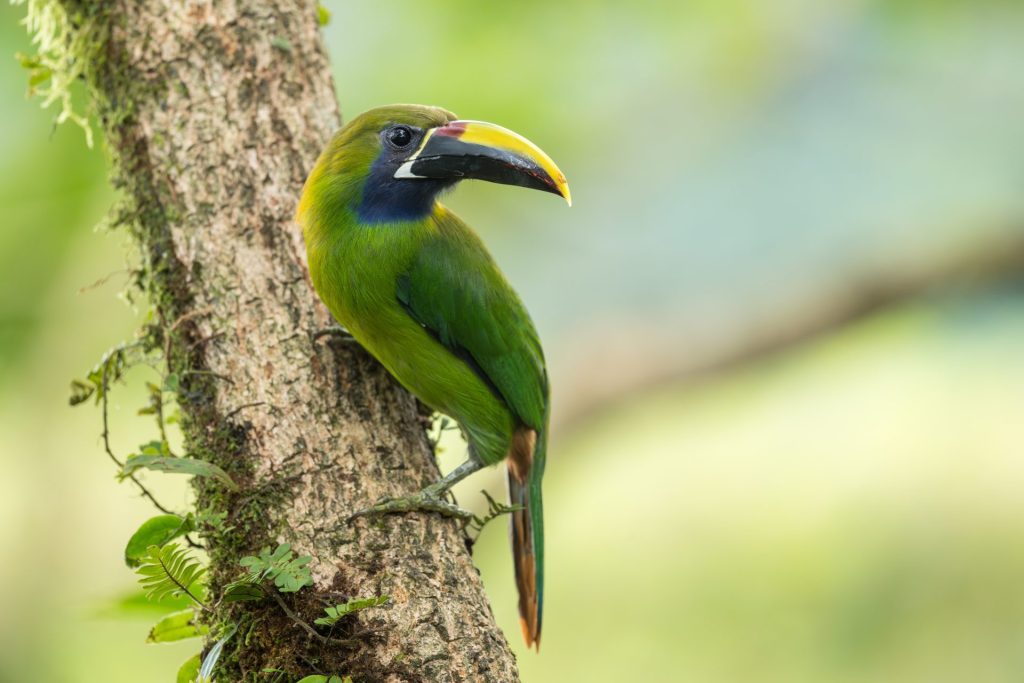
The Darién is one of the last truly wild frontiers, where two continents shake hands. It is a living tapestry of cloud forest, wetland, and mangrove, home to a staggering number of species, including Harpy eagles, Baird’s tapirs, Geoffroy’s tamarins, and even jaguars, though they see us far more often than we see them. Every tree is an archive, every vine a lifeline in a network of interdependence that took millennia to build.
But it’s also a place under siege.
A day earlier, Alexandra had flown over a patch of forest not far from here, where smoke curled upward like a warning. Land squatters and loggers had come again, armed with chainsaws, and the damage was surgical: a swath of old-growth forest had been decimated. From the air, it looked like a wound; from the ground, it felt like one.
She remembers kneeling beside a mountain almond tree stump, its rings wide open and exposed. That tree had been over three hundred years old. It shared its branches with epiphytes and sloths. It had shaded frog eggs in leaf pools and fed generations of beetles, monkeys, and birds. It was now gone.
More than 15 years ago, Alexandra began learning from the Emberá and Wounaan peoples, whose stewardship is essential to ecological and cultural preservation. Facing economic pressures and outside exploitation, they often receive little in return for the use of their land or its resources.
We often talk about protecting biodiversity, and we should. But here in the Darién, biodiversity is not an abstract concept. It has eyes, wings, and hooves. It sings before dawn and rustles through the dark. It’s part of the people, the place, the pulse of something larger than us.
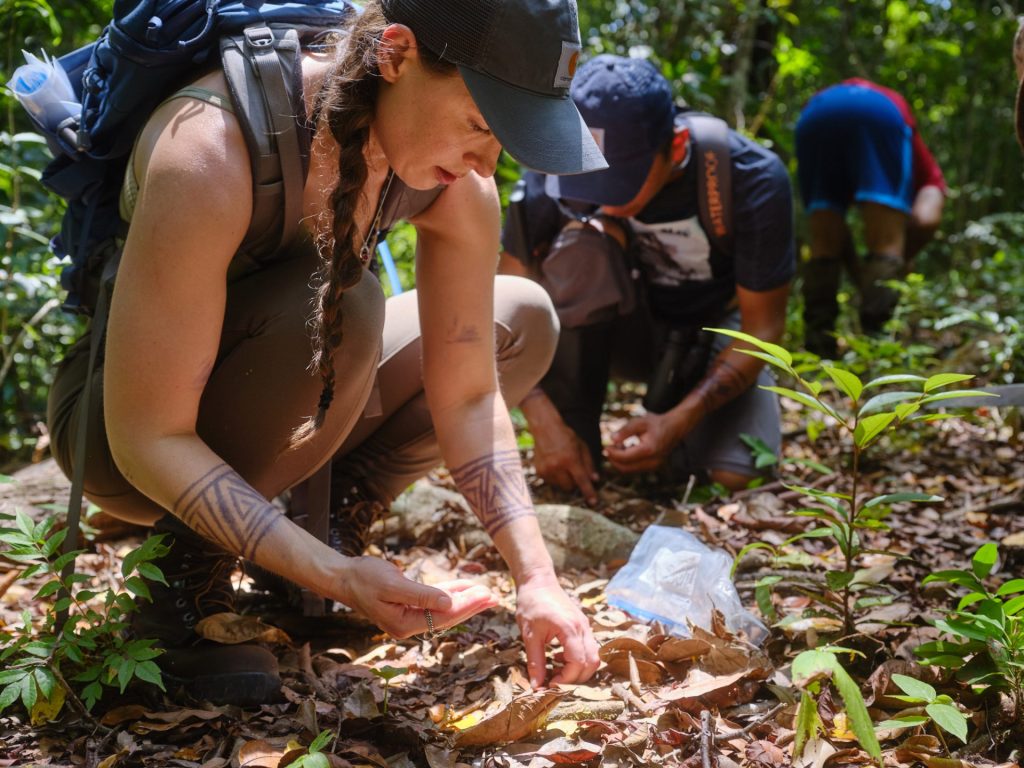
Alexandra Climent is a rainforest conservationist, sculptor, and founder of the Endangered Rainforest Rescue (ERR), a women and Indigenous-led non-profit organization working to restore biodiversity by protecting primary forests and indigenous land in the Darién Region of Panamá. Alexandra has led expeditions for several years into this dense rainforest where she and her team are working to reforest an essential corridor for the critical species like the jaguar. The foundation of their efforts is to use endangered tree species as the building blocks for habitat restoration in deforested areas, reconnecting them to primary forests.
Initially, a sculptor of fallen trees that she found in the rainforests of Panamá, Alexandra learned to make art and fine furniture from the dense wood, often taking inspiration and guidance from Indigenous people. But every time she returned to Panamá, she saw the forests rapidly disappearing and the tree species she used along with it. This is what inspired the creation of the ERR.

Photo Credit: Nicholas Mehedin
At the heart of ERR’s mission is the reforestation of degraded lands by planting endangered tropical tree species. Many of these species are endemic to the Darién and have been severely depleted by illegal logging and land clearing. By sourcing seeds from old-growth forest remnants and cultivating native species in community-run nurseries, ERR revives lost habitats and supports sustainable economic opportunities for local families.
One of their most ambitious projects is the creation of a 5,000-hectare wildlife corridor designed to reconnect fragmented forest landscapes. This corridor will serve as a critical refuge and migration path for endangered species while also bolstering regional climate resilience. ERR integrates modern conservation science with traditional ecological knowledge, ensuring that forest restoration aligns with the needs and wisdom of Indigenous land stewards. In addition to reforestation, the organization is actively involved in environmental education, ecological monitoring, and advocacy for Indigenous land rights. Through a model that bridges grassroots action and global awareness, ERR is building a future where biodiversity is protected and allowed to thrive, ensuring that the voices of the forest and its people are heard, respected, and sustained for generations to come.
The Half-Earth Project Map is a dynamic, science-based tool that visualizes global species richness and conservation priorities to help build efforts toward protecting biodiversity. The Places for a Half-Earth Future layer takes the science of the Half-Earth Project and highlights the most critical locations for conservation action, where species most need protection.
The Darién Region of Panamá is one of the most ecologically rich and culturally significant landscapes in the Americas, effectively acting as a continental biological corridor, connecting North and South America. In the Darién Region, the Places for a Half-Earth Future has identified four areas to extend and connect with the network of existing Indigenous reserves, national parks, and community conservation areas. Priority Places 1269, 1266, 1267, and 364 all contain hundreds of species known to science, and an unknown number of species yet to be catalogued, reinforcing the value and importance of the work by Alexandra Climent and ERR.
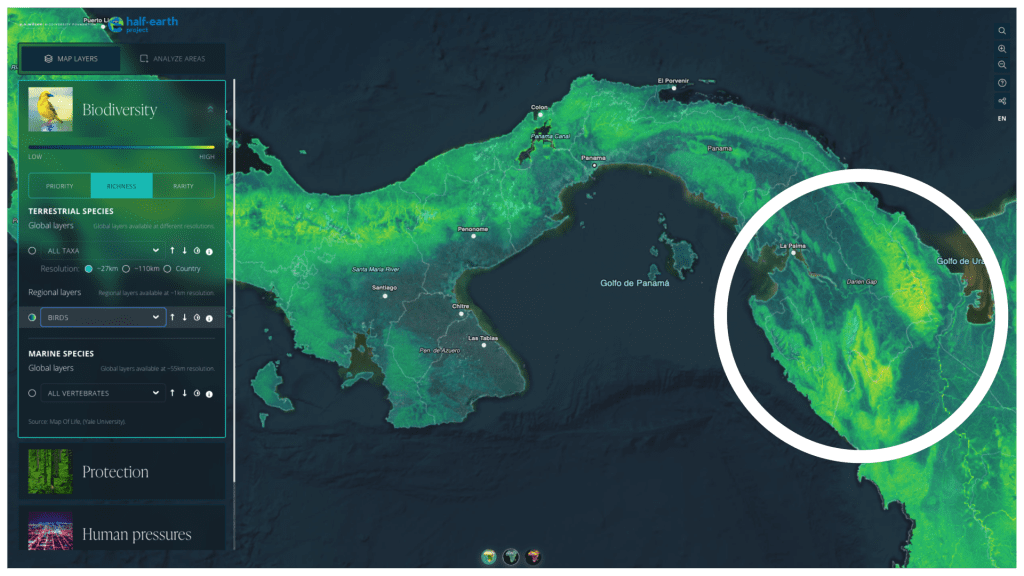
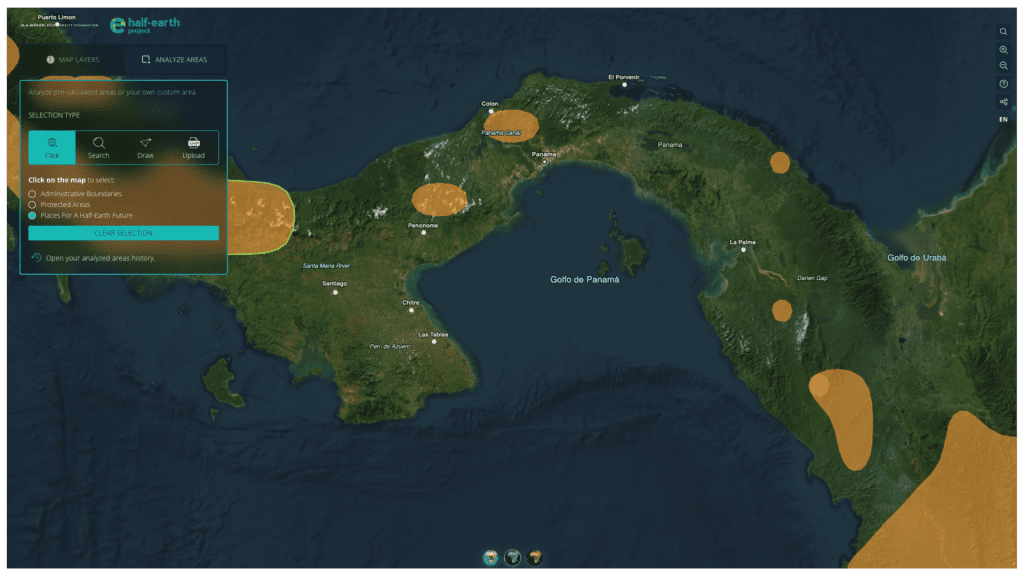
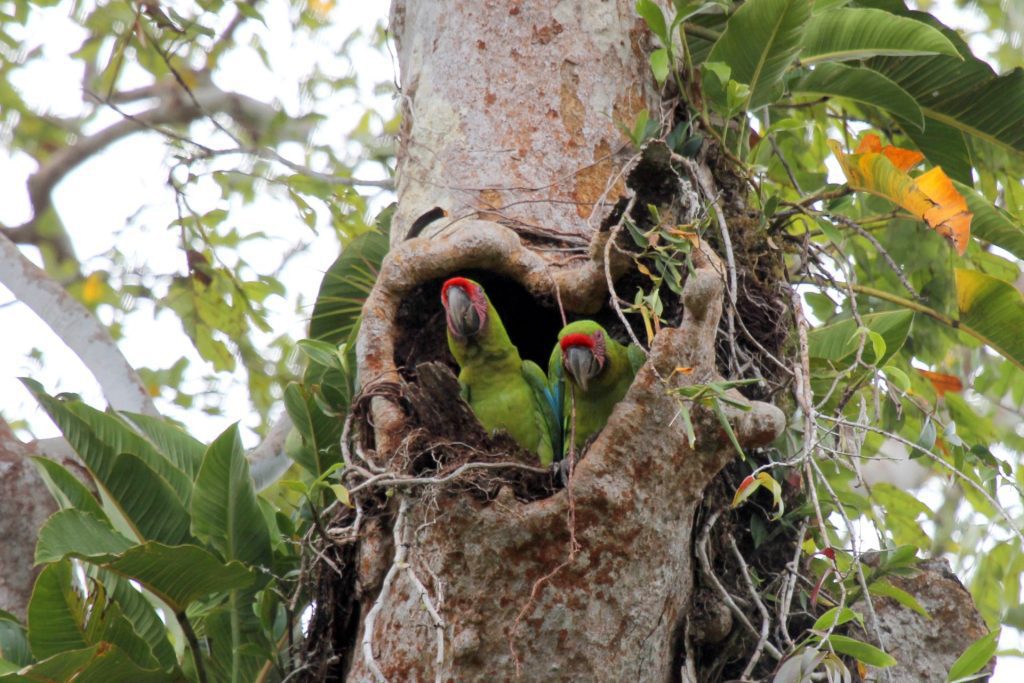
The restoration efforts to connect existing healthy forests are a driving factor for ERR. Moreover, reforesting the Darién rainforest with native tree species like the mountain almond (Dipteryx panamensis) is critical for restoring ecological balance and preserving biodiversity. The mountain almond is a keystone species. Its towering presence provides food, nesting sites, and shelter for a wide range of animals, most notably the Great Green Macaw (Ara ambiguus), a critically endangered parrot that depends on these trees for survival. With widespread logging and deforestation threatening these ancient giants, the macaws have lost much of their nesting habitat, pushing their populations to the brink. By planting and protecting mountain almond and other native species, reforestation efforts not only rebuild forest structure but also revive the intricate web of life that depends on it—ensuring that emblematic species like the Great Green Macaw can thrive once again in the canopy of Darién. Explore more about the Great Green Macaw on the Half-Earth Project Map.
In the heart of the rainforest, where ancient trees breathe life into the world and the songs of rare birds echo through the canopy, the work of the Endangered Rainforest Rescue stands as a beacon of hope. By blending Indigenous wisdom, scientific insight, and community-driven action, they protect endangered ecosystems and restore the balance between people and planet. In alignment with the Places for a Half-Earth Future vision, their efforts illuminate a path forward: one where conservation uplifts cultures, where forests thrive with life, and where protecting the Earth becomes not a dream, but a shared responsibility. The story of the Darién and places like it reminds us that the planet’s future depends on the choices we make today, and that even the most threatened landscapes can flourish when we care, protect, and reimagine what’s possible.
For more information on the Endangered Rainforest Rescue and Alexandra Climent, go to https://www.endangeredrainforestrescue.org
If you or your organization has an idea for a story like this or a question, please contact Brooks Bonner, Program Director of the Half-Earth Project at the E.O. Wilson Biodiversity Foundation, at bbonner@eowilsonfoundation.org.