
Half-Earth Educator Ambassador Teaching Tools
Lesson Plans that Inspire Next-Generation Environmental Stewardship
E.O. Wilson regarded research and education as cornerstones for a new way of understanding the beautiful intricacy of our planet and how we can best steward its enduring stability. The Half-Earth Educator Ambassador Teaching Tools are based on the science of the Half-Earth Project Map, which uses thousands of data points to inform what network of places should be prioritized for conservation so that no species is left behind. Through biodiversity-focused educational materials aligned to state and Next Generation Science Standards (NGSS), the teaching tools connect students with the natural world and create transformative moments that allow them to imagine how they can made a difference in protecting the living Earth.
What Half-Earth Educator Ambassador Teaching Tools are available?
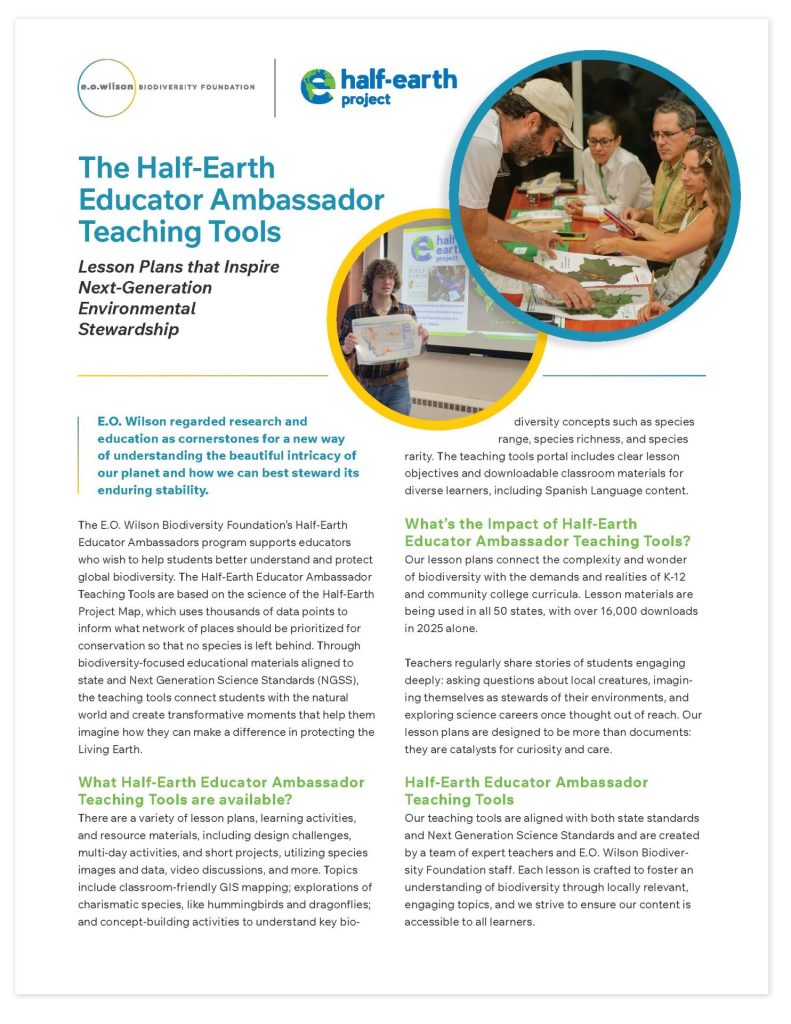
There are a variety of lesson plans, learning activities, and resource materials, including design challenges, multi-day activities, and short projects, utilizing species images and data, video discussions, and more. Topics include classroom-friendly GIS mapping; explorations of charismatic species, like hummingbirds and dragonflies; and concept-building activities to understand key bio- diversity concepts such as species range, species richness, and species rarity. The teaching tools portal includes clear lesson objectives and downloadable classroom materials for diverse learners, including Spanish Language content.
What’s the Impact of Half-Earth Educator Ambassador Teaching Tools?
Our lesson plans connect the complexity and wonder of biodiversity with the demands and realities of K-12 and community college curricula. Lesson materials are being used in all 50 states, with over 16,000 downloads in 2025 alone.
Teachers regularly share stories of students engaging deeply: asking questions about local creatures, imagining themselves as stewards of their environments, and exploring science careers once thought out of reach. Our lesson plans are designed to be more than documents: they are catalysts for curiosity and care.
“The Hearst Foundation is proud to support The Half-Earth Educator Ambassador Program because of its unique model for engaging teachers and students in the exploration of our shared planet. The program is helping to ensure that biodiversity science is accessible to children of all backgrounds and, importantly, helping to educate the next generation of conservation leaders.”
Alison N. Yu, The Hearst Foundation
Half-Earth Educator Ambassador Teaching Tools
Our teaching tools are aligned with both state standards and Next Generation Science Standards and are created by a team of expert teachers and E.O. Wilson Biodiversity Foundation staff. Each lesson is crafted to foster an understanding of biodiversity through locally relevant, engaging topics, and we strive to ensure our content is accessible to all learners.
As a comprehensive atlas of the Earth’s biodiversity, the Half-Earth Project Map supports public understanding and education. It is an authoritative resource for communicating, visualizing, and understanding global progress in conservation. Its unique public-facing mission translates the complexity of conservation science into an accessible, clear, and compelling barometer of local and national conservation success. As countries worldwide have committed to improving biodiversity conservation under the Global Biodiversity Framework and its ‘30 by 30’ target, the Half-Earth Project provides information and understanding that supports achievement of this ambition.
- In-demand lesson plans include topics such as “Bioacoustics, Bats, and Biodiversity” and “Listening to the Oceans: Soundscapes of Coral Reefs.”
- “Half-Earth in U.S. States,” the most downloaded resource, helps students explore the biodiversity of their own communities.
- “Using the Half-Earth Project Map” supports educators seeking to build data literacy, equipping students to analyze ecological data and understand large-scale conservation efforts.
What’s a Half-Earth Project Map Design Challenge?
Using design challenges, students become conservation decision-makers, using the same professional data tools as scientists to propose evidence-based conservation strategies for their state or region. Using data from the Half-Earth Project Map and other provided resources, students examine biodiversity patterns and key species that make specific places worth protecting.
Design Challenge at a Glance
- Explore: Teachers select a geographic area and pro-vide students with visual, sortable species data cards featuring photos; range maps; species protection scores; and endemism percentages.
- Analyze: Students examine existing protected areas alongside human land use (agriculture, development, energy, transportation).
- Propose: Students identify high-biodiversity areas with minimal human impact, then compare their solu-tions against professional biodiversity maps from the Half-Earth Project Map.
- Defend: Through iterative design and scientific dis-course, students refine and justify their conservation proposals.
Are you an educator looking for biodiversity education materials for your classroom?
In addition to being a leading scientist and communicator, E.O. Wilson was a popular college professor, mentoring four decades of students. He believed passionately in the power of education and in adopting new methods and technologies. We honor his commitment and legacy through the Half-Earth Educator Ambassadors network, an active network of educators engaging youth in biodiversity science and conservation. Today the network includes U.S. classroom teachers across disciplines looking for ways to bring biodiversity and conservation into their curriculums— from life sciences to arts and humanities, as well as non-formal educators within outreach organizations such as nature centers.
Why Teachers Love Half-Earth Teaching Tools
- Customizable – Adaptable to any geographic scale or taxonomic group
- Data Literacy – Students trace links to original observations and studies
- Critical Thinking – Human impact layers spark evidence-based discussions
- Actionable – Shows students how citizen science informs real conservation
- Interdisciplinary – Integrates math, science, social studies, and literacy
- Student Agency – Learners make authentic decisions using professional tools
- NGSS Aligned – Three-dimensional lesson adaptable from grade 3 to 12.
Meet our Master Ambassadors!

Linda Rost, Ph.D., is a high school science teacher in Baker, Montana, teaching biology, anatomy and physiology, chemistry, AP Biology, and science research and serves as an adjunct instructor at Miles Community College. Dr. Rost is a nationally recognized educator and the Montana recipient of the 2023 Outstanding Biology Teacher Award, the recipient of a NEA Award for Teaching Excellence, and a Finalist for the Presidential Award for Teaching Excellence. In 2020, Dr. Rost was Montana’s Teacher of the Year and Top 4 Finalist for National Teacher of the Year. In addition to her classroom achievements, Dr. Rost is an experienced curriculum writer with expertise in content development, and is well-versed in culturally responsive pedagogy. She has extensive experience in teacher professional development, where she has provided professional keynotes, presented at local, state, national, and international conferences, and published her work in peer-reviewed science education journals. Dr. Rost lives on a cattle ranch in Montana with her husband, three children, and an elaborate hobby chicken farm, complete with peacocks.
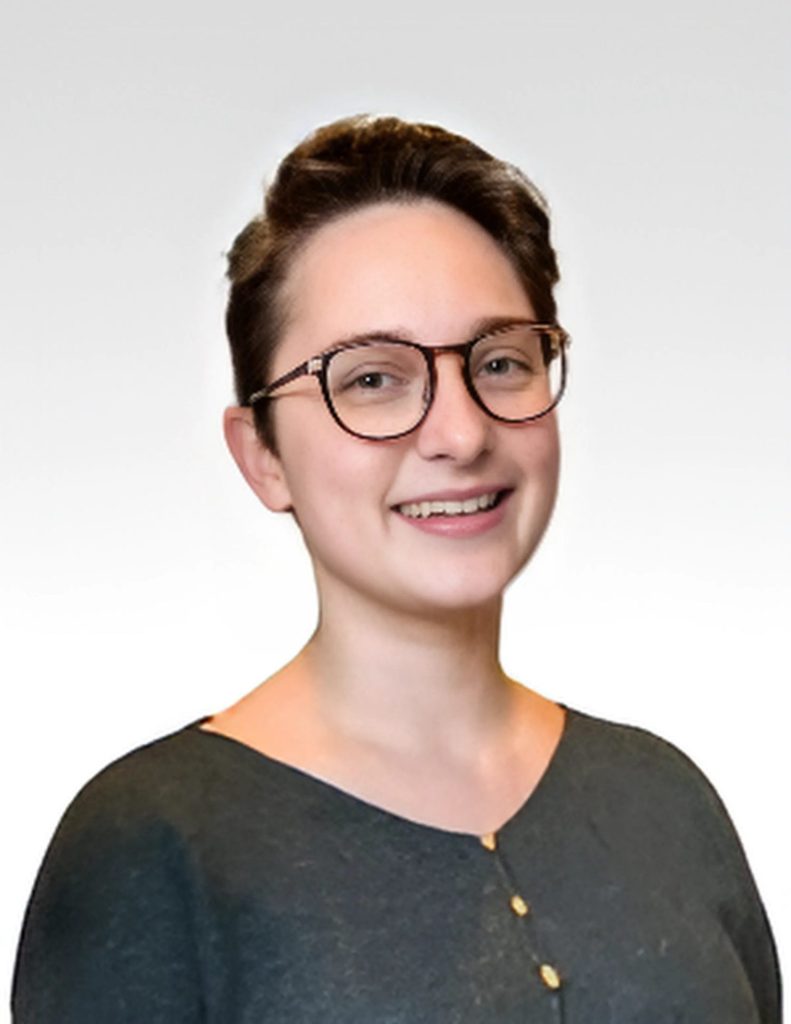
Enya Granados is in her seventh-year teaching as a high school life science teacher in Athens, Georgia. Enya has a passion for curriculum writing and has worked with BSCS Science Learning as a curriculum teacher co-writer on climate change. She is involved in the National Association of Biology Teachers (NABT) as an active member who presents regularly as well as chairs the organization’s Justice, Equity, Diversity and Inclusion committee. Enya was awarded the Knowles Teacher Fellowship in 2018 and NABT’s Outstanding New Biology Teacher in 2021. She was a state finalist for the Presidential Award for Excellence in Mathematics and Science Teaching in 2025. Enya is also a 2025 HHMI BioInteractive Ambassador Academy Member. She has published in Teaching and Teacher Education and the National Center for Case Study Teaching in Science. Enya is passionate about designing localized phenomena lessons that empower her students to make local changes in their community.

Lucretia Smith serves as the UNC Principal Fellows- Assistant Principal Intern for Wake County Public Schools in North Carolina. She is a dedicated educator focusing on discipline, curriculum, student support, supervision, safety, parent engagement, administration, special programs, and staff development. Previously, she was a Curriculum Specialist for Scholars to College at the Emily K Center in Durham. In this role, she was responsible for developing and delivering curriculum, serving as the primary instructor for college readiness, and collaborating with staff for planning and record-keeping. Lucretia’s curriculum development and delivery expertise complement her comprehensive background as a Science Teacher at Healthy Start, now named Durham Charter School Upper School, where she served as the 7th and 8th Lead Teacher. As a 5th Grade Teacher, she created, developed, and implemented core elementary school curriculum. She also developed lesson plans tailored to individual students’ abilities, assigned homework, provided special attention to students in need, and taught various subjects. Her use of diverse instructional strategies, including lectures and group discussions, ensured the effective translation of lesson plans into meaningful learning experiences.

Missie Olson, Ph.D., is a high school science teacher in Becker, Minnesota, where she teaches biology, earth science, and Dual Credit Environmental Science. She is also an adjunct faculty member at Bethel University. Dr. Olson received the 2023 Outstanding Earth Science Teacher Award for Minnesota and was selected as a 2021 State Finalist for the Presidential Award for Excellence in Science and Math Teaching. Dr. Olson has extensive experience in curriculum design, with expertise in NGSS three-dimensional learning practices. She serves as the Minnesota Science Teachers Association’s regional representative, has presented at state, national, and international conferences, and has published work in peer-reviewed science education journals. To reach beyond her community while engaging more deeply with her students, Dr. Olson created the Becker Amazing Earth Project, where she and her students capture, curate, and share photos of nature and explain the scientific phenomena behind them.

Robyn Embry, Ph.D., is a high school science teacher in Mitchell, Indiana, where she teaches AP and Dual Credit courses in Environmental Science, Biology, and Biotechnology. She has also served as an adjunct instructor of Biomanufacturing at Ivy Tech Community College and an AP Environmental Science exam reader for the College Board. Robyn has received numerous accolades, including the 2024 Gene Stratton-Porter Environmental Science Award and the 2019 Soil and Water Conservation District: Conservation Teacher of the Year. As a leader in her field, Robyn has served on the Indiana Department of Education’s Climate Change Resource Team and is actively involved in the North American Monarch Institute, where she and her students have contributed to Monarch research and conducted outreach programs within their community. Robyn is a highly-engaged member of the educational community, serving as a teacher mentor for Purdue’s Summer Energy Academy and sharing her work through conference presentations and peer-reviewed publications.

Selim Tlili teaches high school biology at The Beekman School in Manhattan, New York, and was formerly an educator at the Rudolf Steiner School and in New York City Public Schools. Selim has roots in Puerto Rico and Tunisia and studied biology before earning master’s degrees in environmental health at Hunter College and environmental humanities at Harvard University. Selim participated in an introductory GIS mapping workshop that Esri made available to Half-Earth Educator Ambassadors. As a result, he has been able to offer projects for his students right in their school neighborhood. Selim is an experienced curriculum developer who contributed to several teaching tools featured on the E.O. Wilson Biodiversity Foundation’s Education Page. In addition to his stellar teaching and writing skills, Selim is fluent in both English and Spanish and helps translate Educator Ambassador materials into Spanish.

Wendi Pillars, NBCT, Army veteran and Mom, has been teaching for nearly 30 years, K-12, stateside and overseas, in both military and civilian contexts. She currently teaches science in Chatham County, North Carolina, but has experience in a range of subjects and especially loves working with language learners and immersing students in the scientific wonders that surround us. Wendi is the author of two books, including the most recent award-winning “Visual Impact: Quick, Easy Tools for Thinking in Pictures.” She is a National Geographic Certified Educator, served as part of the inaugural Teacher Advisory Council for National Geographic, and has facilitated multiple cohorts of their Climate Change Educator Course. A relentlessly curious learner, artist, author, athlete, beekeeper, and entrepreneur, she has broad curriculum development experience. Her biggest passion? Empowering the next generation of leaders to tackle global challenges with confidence and compassion. She is a longtime advocate for the wellness of people and our planet and was selected in 2023 as one of 100 Women in STEMM worldwide to be a part of the Homeward Bound Projects. Find her at the baseball field or with her rescues, Ceidy and Bandit.